The short version: General pest control is the ongoing service that keeps common household pests — ants, cockroaches, spiders, crickets, silverfish, earwigs and similar invaders — from establishing themselves inside your home. A local provider starts with an inspection, treats the places pests actually live and travel (cracks, crevices, entry points, the exterior foundation line), and then maintains an exterior barrier on a recurring schedule so most pests are stopped before they get indoors. When you call through PestReach USA, we connect you with an independent local licensed provider who inspects first and treats second — the opposite of a one-size-fits-all spray visit.
What general pest control actually covers
General pest control is a category, not a single treatment. It covers the routine crawling and flying insects that turn up in kitchens, bathrooms, basements and garages: pavement ants and odorous house ants, German and American cockroaches, house spiders, crickets, silverfish, earwigs, centipedes, pillbugs and pantry pests, among others. Most general programs are built around an inspection, an initial interior-and-exterior treatment, and then recurring exterior services — commonly every other month or quarterly — that keep a protective barrier in place around the structure.
What general pest control does not usually cover matters just as much. Termites, bed bugs, rodents and wildlife each require dedicated inspection methods, equipment and treatment plans, which is why they have their own services. A good provider will tell you plainly when a problem falls outside a general plan rather than treating it with the wrong tools. Fleas and ticks, mosquitoes and stinging insects also typically sit in their own programs, because the treatment sites — yards, harborage areas, nests — are completely different from a foundation barrier service.
Signs your home needs more than a DIY spray
A single spider in a corner is not an infestation, and most homes can handle the occasional invader. The signs that point to a real, established pest presence are different: ants trailing in a line along a baseboard or countertop edge, roach droppings that look like coarse black pepper in cabinet hinges, shed skins or egg cases in storage areas, silverfish in bathroom cabinets week after week, or the same pest appearing in several rooms at once. When you see pests during the day in numbers, there are almost always more in the hidden places — wall voids, under appliances, inside the gaps around plumbing.
Store-bought sprays often make these problems harder to solve. A contact spray kills the insects it touches but can scatter a colony — German cockroaches and some ant species are well known for budding or relocating when hit with repellent products, splitting one problem into several. Bait-based and non-repellent professional treatments work the opposite way: pests walk through them or feed on them and carry the material back to the nest, which is why identification of the species matters before anything is applied.
- Ant trails that keep returning to the same entry point
- Roach droppings or egg cases in cabinets and appliance voids
- The same pest showing up in multiple rooms
- Pests visible during daylight hours, not just at night
- Activity that returns within days of a DIY treatment

How a professional service visit works
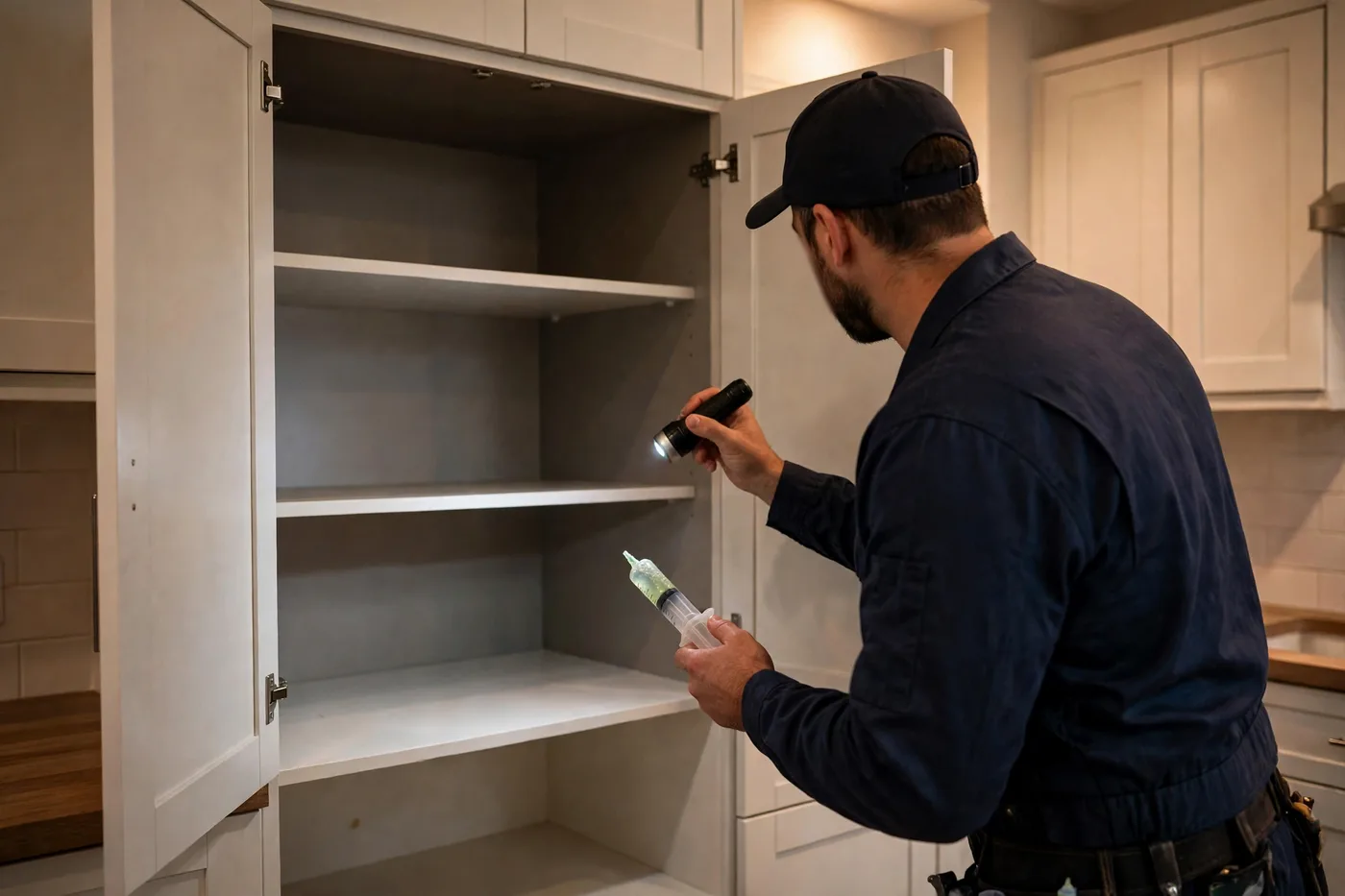
The first visit is the longest, because it starts with identification and inspection. The technician walks the exterior first — foundation cracks, weep holes, utility penetrations, door sweeps, window frames, mulch beds pushed against the siding — then moves inside to kitchens, bathrooms, basements and attics where moisture and warmth concentrate. The goal is to answer three questions: which species, where are they getting in, and what is attracting them. Only then does treatment begin.
Treatment itself is targeted. Crack-and-crevice applications go where pests harbour, bait placements go where they feed, and the exterior gets a barrier band around the foundation, eaves and entry points. Most modern general programs emphasize the exterior on follow-up visits — if the barrier keeps pests out, interior treatment is needed less often, and many providers will re-enter and treat inside on request or when interior activity is found. You will typically be told what was applied, where, and what to watch for in the following days; a brief increase in visible activity right after treatment is common as insects are flushed from harbourage.
- Inspection of exterior entry points, then interior hot spots
- Species identification before any product is chosen
- Crack-and-crevice and bait treatments where pests live and feed
- Exterior barrier around the foundation, eaves and doors
- A written or digital summary of what was done and what to watch for
Integrated pest management: the part that makes it last
Professionals use the term integrated pest management — IPM — for a simple idea: chemicals are one tool, not the whole toolbox. Exclusion (sealing gaps, repairing screens, fixing door sweeps), sanitation (removing food and water sources), and habitat changes (moving firewood off the ground, thinning mulch against the foundation, trimming branches off the roofline) often matter more to the long-term result than any spray. A provider who only sprays and never mentions the gap under your back door is skipping the step that keeps the problem from returning.
At home, the highest-value habits are unglamorous: wipe up spills and crumbs, store pantry food in sealed containers, fix the slow drip under the sink, empty the pet's water bowl at night in problem areas, vacuum along baseboards where egg cases hide, and reduce clutter in basements and garages where spiders and silverfish thrive. None of this replaces treatment for an established infestation, but it decides how well treatment holds between visits.
How often does a home need service?
Most general programs run on a recurring cycle — monthly for heavy pressure, every other month or quarterly for typical homes — because exterior treatments weather down over time and because pest pressure is seasonal. Ants surge in spring, spiders and crickets move in during late summer and fall, and overwintering insects probe the house as temperatures drop. A plan that matches visits to that rhythm keeps the barrier fresh ahead of each wave instead of reacting after pests are already inside.
One-time treatments exist, and they make sense for a defined problem — a single wasp nest is a different service, and a home being prepared for sale may need a single clean-out. But for the common crawling pests, a one-time visit without follow-up usually means the eggs and hidden harbourages that were not reached simply restart the cycle. Your provider should explain which pattern fits your situation and why, in plain language, before you commit to anything.
What to ask before you book
Ask which pests the plan covers and which it excludes, what products and methods will be used inside your home, whether follow-up visits between scheduled services are available if activity continues, and what preparation — if any — is expected of you. Ask whether the company is licensed in your state for pest control work and whether the technician will be the one to inspect, or whether inspection and treatment are split. Clear answers to those questions tell you more about a provider than any advertisement.
Through PestReach USA, you describe your problem once and we route your call to an independent local provider who serves your area. That provider — not PestReach USA — sets the schedule, performs the work and stands behind it. Comparing what two providers say about the same problem is a reasonable step, and a trustworthy one will not pressure you to decide on the doorstep.
A closer look: what 'barrier' really means
The exterior barrier is the heart of a general programme, and it is widely misunderstood as a force field. In reality it is a treated band — typically around the foundation, entry points, eaves and the places utility lines penetrate the wall — through which insects must walk to get inside. Contact with the deposit is what works on them, which is why the quality of a barrier service is measured in coverage and continuity rather than volume: a fast pass with a hose-end sprayer that leaves the shaded north side, the weep holes and the gaps behind the meter box untreated is a barrier with doors in it.
Barriers also decay on a schedule set by weather, not by the calendar page. Sunlight breaks deposits down, rain and irrigation wash them, and the dust and pollen of a season coat them. This is the entire logic of recurring service intervals — the visit rhythm exists to renew the band before its gaps line up with the season's pest surge. A provider who can explain why your home is on the interval it is on — shade, soil type, irrigation pattern, surrounding habitat — is describing your property, not a script, and that specificity is worth listening for.
Finally, the barrier is deliberately the second line of defence. The first is the building itself: sealed gaps, sound screens, door sweeps that meet the threshold, dry foundation beds. Programmes that treat exclusion as part of the service — pointing out, and often sealing, the entries they find — hold their results with less chemistry over time. When you compare providers, comparing what they do about the holes is at least as informative as comparing what they spray into them.
How a general pest control request is handled
When you call PestReach USA about general pest control, the call is routed to an independent local provider who does this work in your area. Three things speed everything up: where the activity is, when it started, and what you have already tried. On urgency: routine general problems are scheduled in normal order, and the inspection sets the pace from there. The provider arranges the inspection directly with you, explains the plan and their terms before any work, and confirms their licence and insurance on request. PestReach USA does not set the provider's prices or schedule — but a problem described precisely reaches the right specialist first time, and that is worth more than any other shortcut.
One more thing worth knowing before you call: you do not need to have identified the pest yourself, and you do not need to have prepared anything beyond safe access to the area. Identification is the provider's first job, and preparation instructions — where any are needed — come from them, specific to the method they will use at your property. If you have photographs or notes about when the activity is worst, mention them; they help the inspector start in the right place.