The short version: Ants are the most common reason Americans call a pest control company, and the most commonly mishandled by DIY spraying. Professional ant control starts with identifying the species — because a carpenter ant, a fire ant and an odorous house ant need different strategies — then uses baits and non-repellent treatments that the workers themselves carry back to the colony, combined with sealing the entry points and removing the food and moisture that drew them in. When you call through PestReach USA, we connect you with an independent local licensed provider who will identify what you actually have before recommending anything.
The ants that invade homes, region by region
Odorous house ants are the small brown-black ants trailing to kitchen sinks and sweets across most of the country; they nest in wall voids, mulch and under stones, smell faintly of rotten coconut when crushed, and are notorious for budding — splitting into new colonies — when hit with repellent sprays. Pavement ants nest under slabs and driveways and push up through expansion joints. Pharaoh ants, tiny and yellowish, infest hospitals, apartments and warm buildings across the South and are another budding species where spray-only approaches fail outright.
The structural threats are carpenter ants — large black (or red-and-black) ants that excavate nesting galleries in damp or previously water-damaged wood across the Northeast, Midwest, Pacific Northwest and wooded suburbs everywhere. In the South and along the Gulf, invasive species dominate: red imported fire ants ruling yards with stinging mounds, tawny crazy ants overwhelming properties by sheer number around the Gulf Coast, and Argentine ants forming block-wide supercolonies in California and the Southeast. White-footed ants complicate Florida control. The map of 'your ant problem' is genuinely regional, which is why a local provider's first job is a correct name.
Why identification decides the treatment
Ants eat differently by species and by season — the same colony may take sweet baits in spring and protein or grease baits in summer — so bait acceptance is a species-and-timing question, not a brand question. Nesting sites differ just as much: a pavement ant colony under a slab is reached through cracks and expansion joints, a carpenter ant parent colony may be in a tree or stump outside with satellite nests in the walls, and a fire ant problem is a yard problem measured mound by mound. Treatment built on a wrong or missing identification sprays the symptom and leaves the colony — the reason so many homeowners conclude that 'pest control doesn't work on ants.'
Professionals also reach for non-repellent liquid treatments for the structure's exterior: foraging workers cross the treated zone without detecting it, pick up the material, and transfer it through the colony by contact and grooming. Combined with well-placed baits inside — at trail points, under sinks, behind appliances — this two-front approach is the modern standard, and it explains why patience over two to four weeks beats a dramatic one-day knockdown that simply relocates the nest.
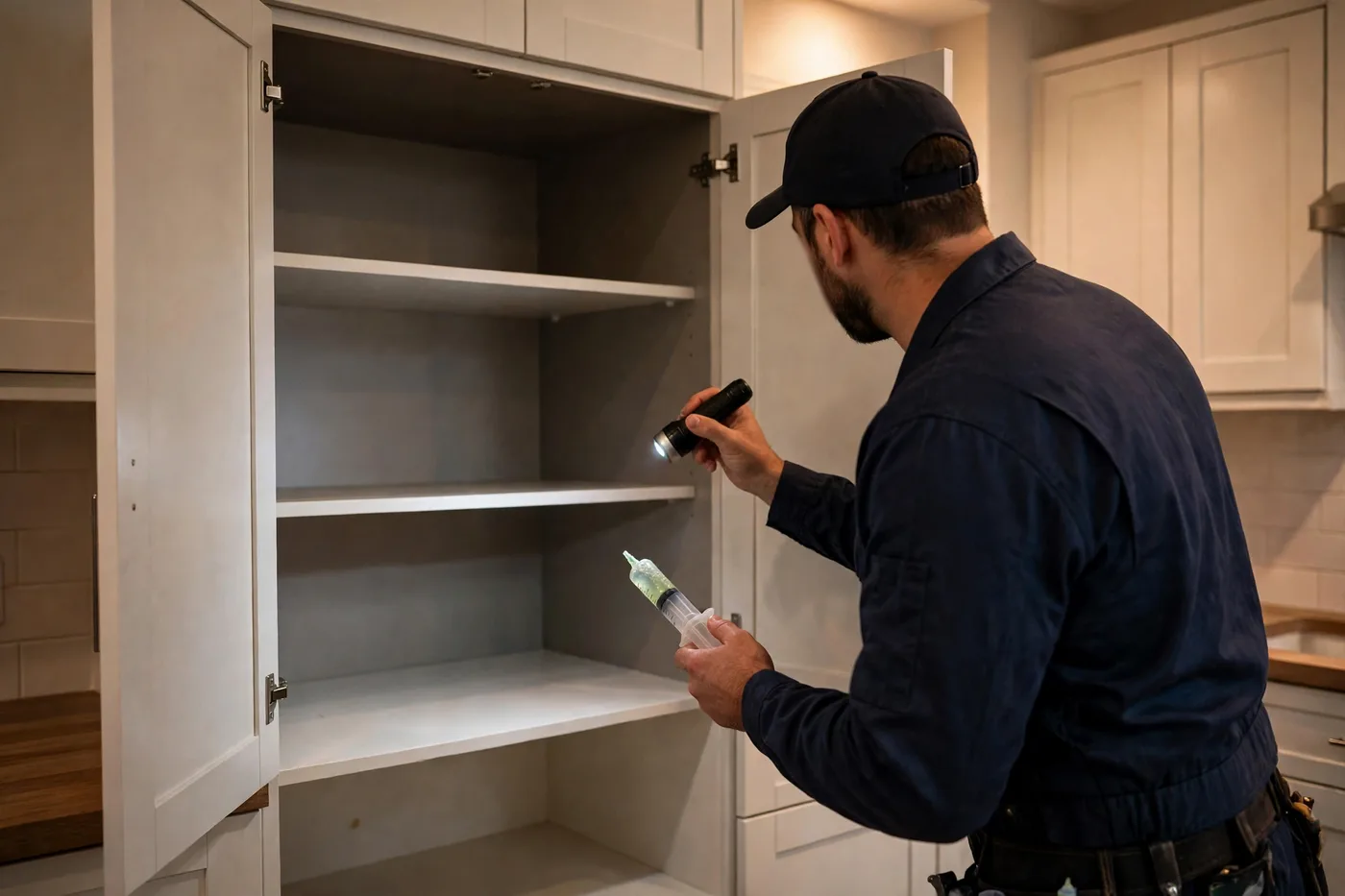
Carpenter ants: the wood-destroying exception
Carpenter ants deserve separate attention because they damage structures. They do not eat wood — they tunnel it to nest, preferring wood softened by moisture: around leaking windows, under flat roofs, in porch columns, bath traps and foam insulation. Activity often goes unnoticed for years because the main colony may be outside in a tree, stump or landscape timber, with the house hosting a satellite nest. Signs to take seriously are piles of frass with insect body parts, ants trailing strongly at night, and swarmers appearing indoors in spring.
Treatment locates and treats the nests directly where possible (void treatments, gallery injection), applies non-repellent perimeter treatment to cut off the traffic, and — critically — fixes the moisture condition that made the wood attractive, replacing decayed members where needed. Skipping the moisture fix is how carpenter ant problems recur: the colony is gone, but the invitation remains nailed to the house.
- Frass (coarse sawdust with insect parts) below kick-out points
- Smooth, clean galleries inside damp or decayed wood
- Large ants trailing at night, especially in spring
- Faint rustling sounds inside walls or woodwork
- Winged swarmers indoors in late winter or spring
Fire ants and yard-scale infestations
Red imported fire ants dominate the Southeast, Texas and the southern plains, and are established in parts of the Southwest and California. Their mounds appear after rain in lawns, along sidewalks and around electrical equipment, and disturbing one brings hundreds of stinging workers. Control works at two scales: broadcast bait applications across the yard in spring and fall, which workers carry to queens throughout the area, and individual mound treatments for fast relief at specific spots. Electrical and utility housings deserve their own checks — fire ants are drawn to them and can damage equipment.
For block-scale invaders like Argentine and crazy ants, honest providers will tell you the goal is suppression and exclusion rather than permanent eradication: wide perimeter treatments, landscape management, and sealing the structure, maintained on a schedule. Overpromising total elimination of a supercolony species is a sales line, not a service plan.
After ants: the habits that hold the line
Ants found your home worth visiting; control changes their arithmetic, and these habits keep it changed. Most are quick: a tube of sealant around the utility entries, a repaired drip under the sink, branches cut back so they stop bridging ants past the treated perimeter. In fire ant country, a twice-yearly broadcast bait rhythm keeps mound pressure low across the yard.
If ants are streaming into your kitchen, wood shavings are appearing under a window, or mounds are taking over the lawn, start with identification. Through PestReach USA we connect you with a local provider who will name the species, explain the colony logic behind the plan, and give you a realistic timeline — the three things a can of spray never tells you.
- Seal gaps around windows, doors, pipes and wiring entries
- Fix leaks and dry out damp areas ants use for nesting
- Store food and pet food sealed; clean sugary spills promptly
- Trim trees and shrubs off the structure
- Manage aphids on foundation plants; reduce honeydew sources
- Keep mulch thinner near the foundation and off siding
A closer look: reading ant trails like a professional
An experienced technician reads an ant trail the way a tracker reads sign. Where the trail emerges — a window frame, a pipe penetration, the expansion joint of a slab — says where the colony is travelling from. What the foragers are carrying, and in which direction, says what the colony is feeding on this month. Whether the trail is a single file or a two-way highway says how established the route is. This is why the first minutes of an ant call are spent watching rather than spraying: the trail is the map of the problem, and destroying it with a repellent spray before reading it is the amateur mistake the whole profession is organised to avoid.
Trail-following also decides where baits go. A bait station placed six inches off a live trail is furniture; placed on the trail, at the harbourage edge and at the entry point, it becomes part of the colony's food system within hours. Technicians will sometimes place two bait types side by side — a carbohydrate gel and a protein granule — and let the ants vote, because the colony's current appetite is a fact to observe, not a theory to argue with. On follow-up visits the vote itself is data: a switch from sweet to protein feeding tells the technician the colony's brood cycle is turning, and the bait programme turns with it.
The same patience applies outdoors. Following a carpenter ant trail at dusk — they are busiest after dark — leads from the house to the tree, stump or fence post holding the parent colony, and treating that colony, not just the satellite in the wall, is what ends the annual return. Fire ant work reads the yard instead: mound density, the brood pattern inside a opened mound, and where new mounds are pioneering. In every case the principle holds — the visible ants are the message, and the colony is the address it came from.

How a ant control request is handled
When you call PestReach USA about ant control, the call is routed to an independent local provider who does this work in your area. Three things speed everything up: where the activity is, when it started, and what you have already tried. On urgency: ant calls are routine unless stinging fire ants are involved, in which case say so — it changes the priority and the equipment. The provider arranges the inspection directly with you, explains the plan and their terms before any work, and confirms their licence and insurance on request. PestReach USA does not set the provider's prices or schedule — but a problem described precisely reaches the right specialist first time, and that is worth more than any other shortcut.
One more thing worth knowing before you call: you do not need to have identified the pest yourself, and you do not need to have prepared anything beyond safe access to the area. Identification is the provider's first job, and preparation instructions — where any are needed — come from them, specific to the method they will use at your property. If you have photographs or notes about when the activity is worst, mention them; they help the inspector start in the right place.