Ask what keeps El Centro providers busiest and the answer is bark scorpions, drywood termites and roof rats — pests written into the calendar by a climate where extreme summer heat, very low rainfall and pests adapted to shelter in and around homes. We connect you with a local independent provider who starts with an inspection.
Phone lines: Mon-Fri 7:00 AM-10:00 PM ET | Sat 8:00 AM-10:00 PM ET | Sun 7:00 AM-9:00 PM ET
The pests that matter in El Centro are the ones its climate feeds and its housing shelters — and both are predictable once you read them.
Local weather data tells the story — around 2 inches of annual rain, about 181 days a year reaching 90°F, and an average temperature near 74°F.
Across the El Centro metro — about 181,411 people in 48,844 households — that pressure lands on housing of every age and type.
Bark scorpions are the desert's signature pest: they shelter by day under bark, rocks and debris, hunt at night, climb walls readily, and come indoors after heat, rain or when their prey moves in. Sealing entry gaps, removing harbourage and reducing their insect food supply are the foundations of control. In El Centro, a blacklight walk after dark tells the truth about scorpion pressure around a home — they fluoresce — and sealing plus prey reduction is built on what that walk finds. More about general pest control.
Drywood termites are the quiet specialists of warm, dry country: they colonise wood directly — eaves, trim, framing, furniture — and reveal themselves mainly through piles of seed-like frass beneath kick-out holes. Localised colonies are treated very differently from soil termites, so identification comes first. In El Centro the giveaway is housekeeping: neat little piles of pellets beneath eaves, window frames and attic vents, swept up by homeowners for months before anyone names them. More about termite control & inspection.
Roof rats are climbers that enter at the roof line and live in attics and upper wall voids, travelling along fences, wires and branches. They are a leading cause of contaminated attic insulation and gnawed wiring, and control means trapping plus sealing every roof-level entry. El Centro roof rats run the fences and the tree canopy, so local exclusion work starts with branches off the roof and every eave and vent screened, before a single trap is set. More about rodent control.
Black widows keep to undisturbed, ground-level shelter — woodpiles, meter boxes, under stones and stored equipment — where the female's messy web waits for passing insects. They are shy and bite only when pressed, but their harbourages are exactly where hands go, so those zones get targeted attention. Around El Centro, widow checks focus on the stored and the still — meter boxes, woodpiles, the undersides of patio furniture — where a web can sit undisturbed for a whole season. More about spider control.
Crickets, earwigs and similar ground-level invaders build up in mulch, leaf litter and damp foundation zones, then move inside in late summer and during wet spells. They are handled by the exterior barrier, habitat thinning against the foundation, and sealing the gaps at grade. Around El Centro, the surge follows the season's turn: crickets crowd foundation lines and garage doors as nights cool, and the homes that seal and dry their crawlspaces early are the ones that skip the invasion. More about general pest control.
Odorous house ants are the small dark ants that trail to sinks, pet bowls and anything sweet. They nest in mulch, wall voids and under floors, and their colonies split when sprayed with repellent products — the main reason DIY spraying so often makes them worse. The El Centro routine starts outdoors: trails are followed from the sink back through the wall to the mulch beds and stone borders outside, because that is where the colony lives and where baiting actually reaches it. More about ant control.
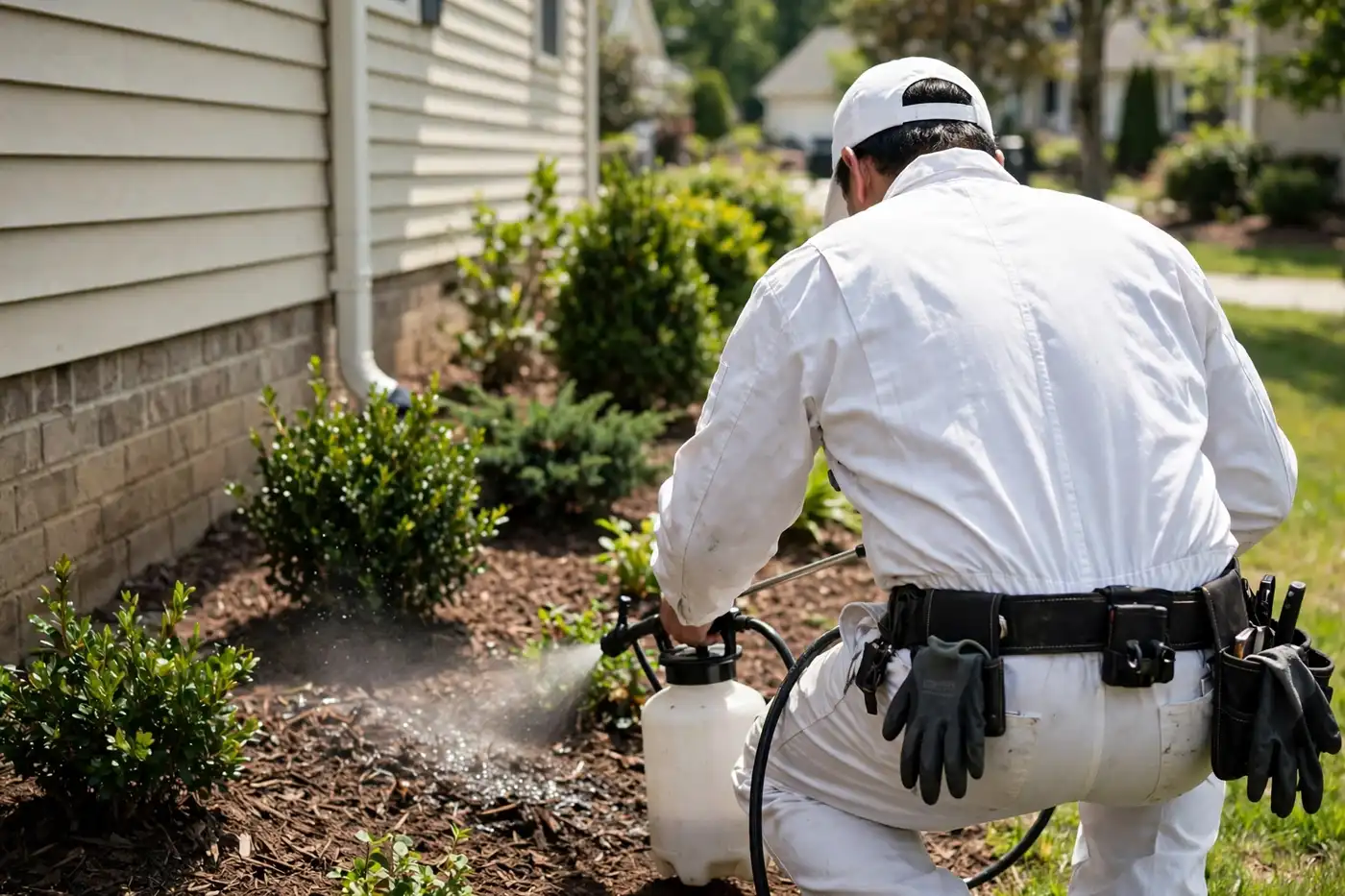

Pest pressure here is seasonal, and the calendar matters more than any single treatment.
Spring: Spring wakes the desert up: scorpions become active, ants trail, and termite inspections turn up colonies that fed all winter.
Summer: Summer heat drives everything toward the house's shade, irrigation and cool voids — scorpions, roof rats, roaches and crickets peak around structures.
Autumn: Autumn — including the monsoon pattern where it applies — flushes pests out of flooded harbourage and into homes in waves.
Winter: Winter slows the desert down but does not empty it; indoor rodents and pantry pests carry the quiet months.
Summer heat is the organising fact in El Centro: extreme temperatures push pests out of exposed ground and into the shade, irrigation and cooled voids of homes. Scorpions, roaches, ants and rodents all concentrate around structures precisely when people are using their yards most.
The same weather produces different problems in different houses, and El Centro's housing mix explains a lot.
Median construction year in the metro is 1988, which places a large share of homes squarely in the era of crawlspace vents, unsealed pipe chases and wood within reach of soil.
Vacancy and turnover play a role too: with 57,511 housing units against 48,844 households, the metro carries the usual share of empty and between-tenant properties — and undisturbed homes are where bed bugs wait out vacancies, rodents nest unnoticed and termite damage runs longest before discovery.
It is why local providers spend so much of an inspection on gaps, vents and door sweeps rather than on product.
What helps most is information: when the activity started, where it concentrates, and what has already been tried. Providers build the first inspection around exactly that.
A local inspection in El Centro follows the pests, not a script. Outside, the technician reads the foundation line, mulch beds, eaves and utility entries for bark scorpions and drywood termites first, because those are the metro's headline problems; inside, the route runs through the kitchen and bathroom plumbing, the attic and any crawlspace or basement the home has. What they write down — species, entry points, conducive conditions — is what the treatment plan gets built on, and it is why two neighbouring homes can legitimately end up with different programmes.

Providers in the network serve the El Centro metro across 14 named communities and the surrounding suburbs. The largest include El Centro (about 44,186 residents), Calexico (about 38,476 residents), Brawley (about 26,934 residents), Imperial (about 20,943 residents), Heber (about 7,308 residents), Calipatria (about 6,549 residents). Note how the list reads: these communities share one pest map — the same climate, the same housing eras, the same seasonal calendar — whatever their municipal boundaries say. A sample of ZIP codes covered locally:
If your ZIP is not listed, call anyway — coverage follows the metro area, not a fixed list, and new routes are added as local providers join.
The metro spans 1 counties. Each county page covers its local pest pressure and the city pages that serve it.
The metro's principal county is Imperial County at about 4,176 square miles; altogether the 1 counties below cover roughly 4,176 square miles. The patchwork matters practically: licences are issued by the state, wildlife rules can vary, and a provider's route is planned county by county — the county pages below give each one its own pest reading.
Pest pressure is regional, and El Centro's map shades into its neighbours': the San Diego, CA metro lies about 82 miles away, Riverside–San Bernardino, CA about 96, and Los Angeles, CA about 166 — close enough that the same weather systems, and largely the same pest calendar, run across all of them. Providers stay local to their own metro, but the reading of the seasons is shared.
Tell us what you are seeing — ants in the kitchen, a nest under the eaves, scratching in the attic — and where you are located.
Your call is routed to an independent local pest control professional who serves your area and handles your type of problem.
The provider inspects, identifies the pest, explains the plan and its terms directly to you, and carries out the work.
The pests El Centro homeowners call about most are bark scorpions and drywood termites, driven by extreme summer heat, very low rainfall and pests adapted to shelter in and around homes. That is as true in El Centro as in central El Centro — local providers plan by metro and county, not by neighbourhood lines. Termites and rodents cause the most expensive damage, while ants and cockroaches generate the most calls. A local inspection settles which problem your home actually has — the answer is often not the pest you expected.
PestReach USA is a referral service and does not set prices — your local provider quotes their own work after inspecting, because the honest price depends on the pest, the size of the property and whether the job is a one-off removal or a recurring programme. Around El Centro, the same answer holds from the core out to El Centro — the providers' routes, not the city limit, define the map. What we can tell you is what drives the figure: infestation size, access, treatment method and follow-up schedule. Be wary of any quote given without an inspection.
There is no single off-switch: pressure peaks from spring through autumn, with bark scorpions leading the warm months, while indoor pests — cockroaches, bed bugs, rodents in the structure — stay active all year. That is as true in El Centro as in central El Centro — local providers plan by metro and county, not by neighbourhood lines. The local pattern is set by extreme summer heat, very low rainfall and pests adapted to shelter in and around homes, so well-timed prevention ahead of your problem pest's peak is worth more than reaction after it.
Availability depends on the local provider's schedule and the urgency of the problem — stinging nests, rodents in living space and confirmed bed bug activity are normally prioritised. In practice, routing follows the metro's real map: ZIP codes such as 92222 and communities like El Centro are on local providers' regular runs. When you call, describe the problem precisely; PestReach USA routes you to a local provider who will give you their real earliest appointment rather than a promise we cannot keep.
Coverage follows the metro rather than the city limit: providers serve El Centro itself — including ZIP codes such as 92222 — and the surrounding communities this page lists, from El Centro outward across the metro's 1 counties. That is as true in El Centro as in central El Centro — local providers plan by metro and county, not by neighbourhood lines. If your address sits near the metro's edge, say so when you call; routing is done on the provider's actual service map, and the neighbouring metros listed on this page are covered by their own local providers if your property falls on that side of the line.
Call now — we will connect you with an independent local provider for an inspection and a clear plan.
Call NowMon-Fri 7:00 AM-10:00 PM ET | Sat 8:00 AM-10:00 PM ET | Sun 7:00 AM-9:00 PM ET