Phone lines open: Mon-Fri 7:00 AM-10:00 PM ET | Sat 8:00 AM-10:00 PM ET | Sun 7:00 AM-9:00 PM ETCall Now

Pest Control in Hilton Head Island, SC

Homeowners deal with subterranean termites, Formosan termites and mosquitoes — a pest calendar written by long, hot, humid summers and mild winters that let pests breed nearly year-round. PestReach USA connects you with an independent local provider who starts with an inspection.

Phone lines: Mon-Fri 7:00 AM-10:00 PM ET | Sat 8:00 AM-10:00 PM ET | Sun 7:00 AM-9:00 PM ET

Pest control in Hilton Head Island

Ask a Hilton Head Island homeowner what pest they battle and you will hear the same few names, because the metro's climate and housing write the same script street after street.

It adds up in the weather record: roughly 45 inches of precipitation annually, 73 days of 90°F-plus heat, and a yearly average temperature of about 67°F.

The Hilton Head Island–Bluffton–Port Royal area is home to roughly 242,966 people, and its 91,214 households share the same pest calendar.

The pests Hilton Head Island homes deal with

Subterranean termites

The species works quietly and socially — a mature colony can number in the hundreds of thousands, all fed through the same foraging territory under and around a home. Treatment is about breaking that territory: bait stations that workers carry back to the colony, or a treated soil zone, verified over follow-up visits rather than assumed. Ask a Hilton Head Island inspector where they look first and it is always the same tour: foundation walls, plumbing penetrations, the wood stacked against the house — the quiet, damp places a colony reaches before a homeowner ever sees a sign. More about termite control & inspection.

Formosan termites

Formosan subterranean termites — established across the Gulf Coast — form colonies far larger than native species and can also nest above ground in walls with a moisture source. Their swarms come on warm, humid late-spring evenings, and they are a genuine reason local inspections take the species seriously. Locally, Formosan pressure concentrates where moisture collects in walls and roofs; Hilton Head Island providers check those voids deliberately rather than assuming a soil-only problem. More about termite control & inspection.

Mosquitoes

Mosquitoes breed wherever water stands — clogged gutters, pot saucers, tarps, low lawn spots — and rest by day in shaded foliage. Local pressure can run most of the year, and the species biting at your patio were most likely hatched within a few hundred feet of it. Providers in Hilton Head Island start with the water audit and are specific about it: a single neglected gutter run can produce mosquitoes for the whole street, which is why the audit covers the property line to line. More about mosquito control.

Red imported fire ants

Fire ants are a fact of yard life here — mound-building, fast to swarm when disturbed, and painful when they sting. Broadcast bait programmes in spring and fall, plus individual mound treatment, are how local properties keep them at a tolerable level. The Hilton Head Island programme is written around the colony's calendar: bait when workers are foraging in the cool of the day, treat mounds directly where they threaten paths and equipment, and re-count mounds at the follow-up rather than assuming. More about ant control.

American cockroaches (palmetto bugs)

The palmetto bug — the large American cockroach — is mostly an outdoor species that wanders in from mulch, leaf litter, sewers and tree holes, especially after heavy rain. Control focuses on the perimeter: harbourage reduction outside, targeted treatment of entry routes, and sealing, rather than heavy indoor application for an insect that does not breed in kitchens. After heavy rain in Hilton Head Island, these big roaches appear in garages and ground-floor bathrooms as flooded harbourage empties — a weather event more than an infestation, handled at the perimeter and the drains. More about cockroach control.

German cockroaches

German cockroaches breed indoors at a pace other roaches cannot match — one egg case carries dozens of young, and a kitchen colony can number in the thousands within months. They live in the warm, tight voids around appliances, hinges and plumbing, which is why local work uses baits placed in those harborage points plus void treatment, repeated as eggs hatch. Providers in Hilton Head Island open the appliance voids first — behind the fridge, under the sink, inside the dishwasher frame — because that warm, dark geography is where this species lives, and where the bait has to go. More about cockroach control.

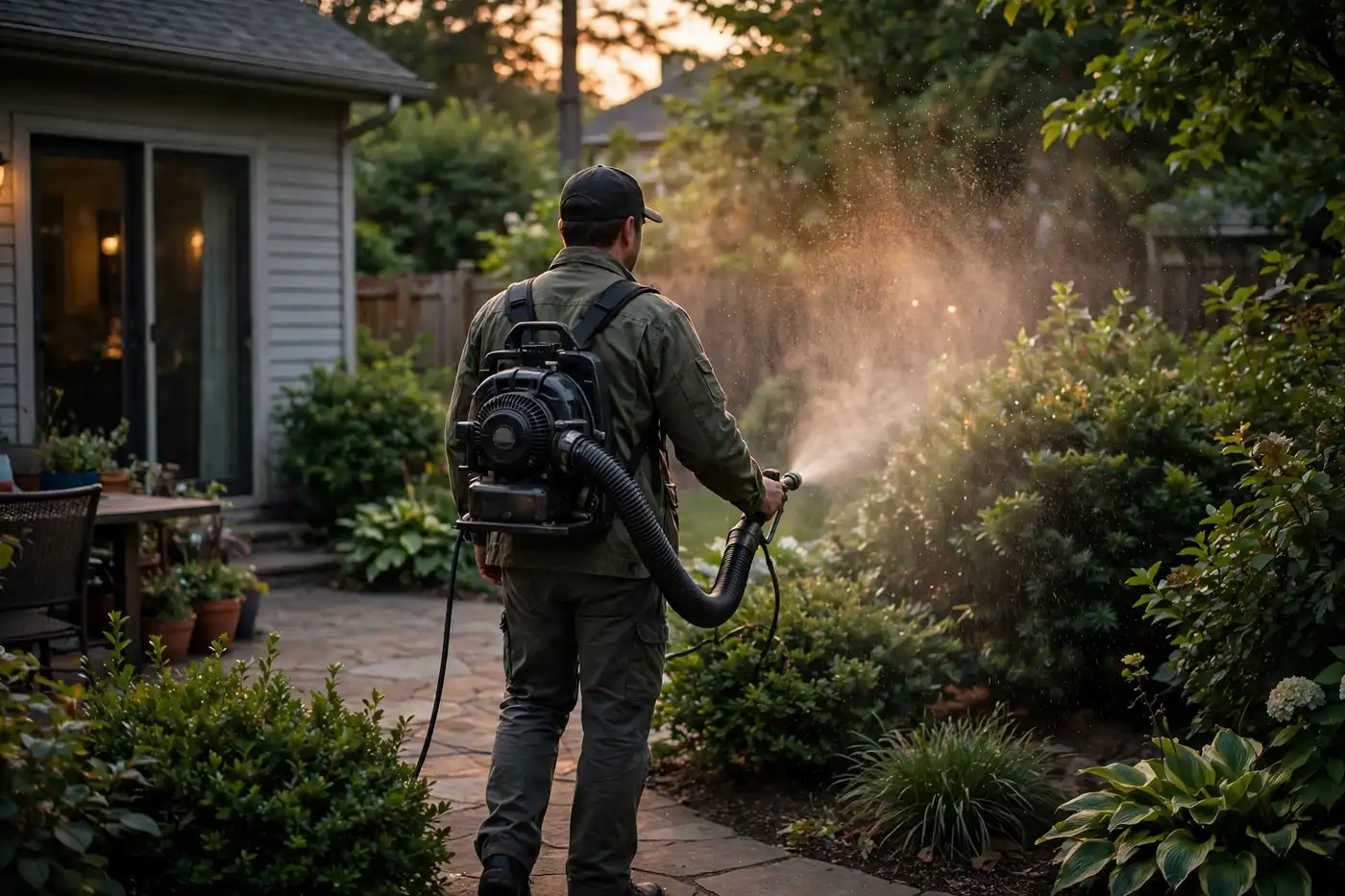
Termite Control & Inspection in Hilton Head Island
The local priority in Hilton Head Island: subterranean termites. Termite Control & Inspection explains how the work is done.

A year of pest pressure in Hilton Head Island

Knowing which pest peaks when is half of local control; this is the Hilton Head Island pattern.

Spring: Spring opens the year hard: subterranean and Formosan termite swarms, fire ant mounds after rain, and the first mosquito waves.

Summer: Summer is the Gulf pattern at full strength — heat, daily storms and standing water everywhere; roaches, ants and mosquitoes peak together.

Autumn: Autumn keeps the pressure high, with rodents moving toward structures and termite colonies still feeding.

Winter: Winter slows outdoor activity but rarely stops it; indoor cockroaches and overwintering rodents carry the season.

Hurricane season writes its own chapter in Hilton Head Island: storm flooding drives ground pests — ants, roaches, rodents — out of drowned harbourage and into homes, often in the same week a property is drying out. Post-storm inspections here look for exactly that displacement, plus the moisture damage that invites termites and carpenter ants in the months that follow.

Hilton Head Island homes and pest risk

What the climate proposes, the housing stock disposes — construction and age decide which homes get hit.

The metro counts about 115,045 housing units; with 17% dating from before 1980, much of the stock has the mature landscaping, settled foundations and utility penetrations that pests exploit.

The building-era mix adds texture: about 36% of homes went up between 1980 and 1999, the era of slab and crawlspace suburbs, while 4% predate 1960 entirely. Each era has its pest signature — older homes leak at every joint; newer ones hide pests in foam, voids and landscape beds built tight against the walls.

Practical translation: exclusion — sealing, screening, sweeping — is worth as much as any treatment in homes of this vintage.

What helps most is information: when the activity started, where it concentrates, and what has already been tried. Providers build the first inspection around exactly that.

What a local inspection covers in Hilton Head Island

Think of the Hilton Head Island inspection as an audit with a torch and a ladder. Outside: the landscape against the walls, the state of the screens and seals, the wood stacked where it should not be. At the foundation: tubes, frass, rub marks, the pencil-width gaps that matter for subterranean termites. Inside: the wet rooms, the voids behind them, then the attic and crawlspace for Formosan termites and whatever else the season has pushed in. The deliverable is a written map — what was found, where, and what the proposed programme does about each find, in order.

Mosquito Control in Hilton Head Island
Second on the Hilton Head Island list: Formosan termites. Mosquito Control covers how that work is done.

Neighbourhoods and ZIP codes covered in Hilton Head Island

Providers in the network serve the Hilton Head Island metro across 14 named communities and the surrounding suburbs. The largest include Hilton Head Island (about 37,805 residents), Bluffton (about 31,323 residents), Port Royal (about 15,047 residents), Beaufort (about 13,660 residents), Hardeeville (about 9,293 residents), Burton (about 7,132 residents). Pest pressure follows the metro's neighbourhoods rather than its municipal lines — a home in any of these communities sits on the same climate and housing map described above. A sample of ZIP codes covered locally:

29902299042990529906299072990929910299122991529920299262992729928299342993529936299402994129943

If your ZIP is not listed, call anyway — coverage follows the metro area, not a fixed list, and new routes are added as local providers join.

Counties in the Hilton Head Island metro

The metro spans 2 counties. Each county page covers its local pest pressure and the city pages that serve it.

The metro's principal county is Beaufort County at about 576 square miles; altogether the 2 counties below cover roughly 1,231 square miles of South Carolina and neighbouring state land. County lines matter for pest work because licensing, and in some areas wildlife rules, run at state and county level — your provider works to the rules where your property sits.

Hilton Head Island among its neighbouring metros

Look outward from Hilton Head Island and the pattern continues: Charleston, SC (about 62 miles), Columbia, SC (about 115) and Florence, SC (about 137) run on much the same pest calendar, driven by the same regional climate. If your property sits between metros, the pages below route you to the one whose providers actually work your address.

Nearby metro areas

Pest control services in Hilton Head Island

How PestReach USA works

1

Call and describe the problem

Tell us what you are seeing — ants in the kitchen, a nest under the eaves, scratching in the attic — and where you are located.

2

We connect you locally

Your call is routed to an independent local pest control professional who serves your area and handles your type of problem.

3

They inspect and treat

The provider inspects, identifies the pest, explains the plan and its terms directly to you, and carries out the work.

Frequently asked questions

When is pest season in Hilton Head Island, SC?

There is no single off-switch: pressure peaks from spring through autumn, with subterranean termites leading the warm months, while indoor pests — cockroaches, bed bugs, rodents in the structure — stay active all year. Locally that plays out street by street — providers cover 2 counties around Hilton Head Island, including the area around Hilton Head Island. The local pattern is set by long, hot, humid summers and mild winters that let pests breed nearly year-round, so well-timed prevention ahead of your problem pest's peak is worth more than reaction after it.

Do I need year-round pest control in Hilton Head Island, SC?

Many Hilton Head Island homes benefit from it, because the exterior barrier that stops most invaders weathers down over one to three months and pest pressure here is not confined to one season. Locally that plays out street by street — providers cover 2 counties around Hilton Head Island, including the area around Hilton Head Island. Homes with lighter pressure — newer construction, few entry points, no history of infestation — may do well with seasonal or as-needed service. An inspection gives you the honest read for your property.

What pests should I watch for in an older home in Hilton Head Island, SC?

With 17% of the metro's homes built before 1980, the recurring themes are pests of gaps and voids: rodents travelling wall voids, carpenter ants in moisture-damaged wood, and insects entering at settled joints and utility penetrations. Homeowners near Hilton Head Island hear the same guidance: the metro's providers work the whole area, ZIP 29902 included. Older homes reward a thorough exclusion pass — sealing and screening — alongside any treatment.

Can a provider help with pests in my attic in Hilton Head Island, SC?

Yes — attics are one of the most common work sites locally, whether the problem is roof rats, squirrels, bats, wasps or overwintering insects. Locally that plays out street by street — providers cover 2 counties around Hilton Head Island, including the area around Hilton Head Island. The correct response is inspection first: identify the animal or insect, find every entry point at the roof line, remove or evict what is there, and seal the entries so the attic stays empty. Treating without sealing is a subscription to the same problem.

How fast can someone come out in Hilton Head Island, SC?

Availability depends on the local provider's schedule and the urgency of the problem — stinging nests, rodents in living space and confirmed bed bug activity are normally prioritised. For Hilton Head Island addresses that map runs across 2 counties, with Hilton Head Island among the communities on regular routes. When you call, describe the problem precisely; PestReach USA routes you to a local provider who will give you their real earliest appointment rather than a promise we cannot keep.

Pest problem in Hilton Head Island?

Call now — we will connect you with an independent local provider for an inspection and a clear plan.

Call Now

Mon-Fri 7:00 AM-10:00 PM ET | Sat 8:00 AM-10:00 PM ET | Sun 7:00 AM-9:00 PM ET