Phone lines open: Mon-Fri 7:00 AM-10:00 PM ET | Sat 8:00 AM-10:00 PM ET | Sun 7:00 AM-9:00 PM ETCall Now

Pest Control in Jacksonville, FL

In this metro the standing problems are subterranean termites, Formosan termites and mosquitoes, shaped by a climate where long, hot, humid summers and mild winters that let pests breed nearly year-round. Call and PestReach USA will connect you with an independent local provider.

Phone lines: Mon-Fri 7:00 AM-10:00 PM ET | Sat 8:00 AM-10:00 PM ET | Sun 7:00 AM-9:00 PM ET

Pest control in Jacksonville

Every metro has a pest signature, and Jacksonville's is written by its weather: long, hot, humid summers and mild winters that let pests breed nearly year-round.

Consider the climate the pests work with: 48 inches of rain in a typical year, 96 days at 90°F or above, and heating demand that shows how real the winters are.

With some 1,785,500 residents across the Jacksonville metro, the audience for these pests is measured in hundreds of thousands of kitchens, attics and crawlspaces.

The Jacksonville area is not one market but 5 counties and 14 communities of quite different housing — and pest work that ignores those differences underperforms. The guides on this site are built metro by metro from real data for that reason, and the providers in the network are local for the same reason.

The pests Jacksonville homes deal with

Subterranean termites

Colonies live in the soil and commute: workers travel through mud tubes into the framing, feed, and return, which is why a house can be damaged for years with almost nothing visible from a living room. Local programmes pair a full inspection with soil or bait treatment and scheduled re-checks of the stations and the foundation line. In Jacksonville, inspectors probe the foundation line and any wood within reach of soil first, because that is where local colonies announce themselves — a single mud tube on an inside crawlspace wall is taken as seriously here as a swarm. More about termite control & inspection.

Formosan termites

Formosan subterranean termites — established across the Gulf Coast — form colonies far larger than native species and can also nest above ground in walls with a moisture source. Their swarms come on warm, humid late-spring evenings, and they are a genuine reason local inspections take the species seriously. In Jacksonville, the tell-tale is often found overhead: inspectors carry ladders here because this species nests in roofs and wall voids wherever a slow leak keeps timber damp, far above the soil line most people associate with termites. More about termite control & inspection.

Mosquitoes

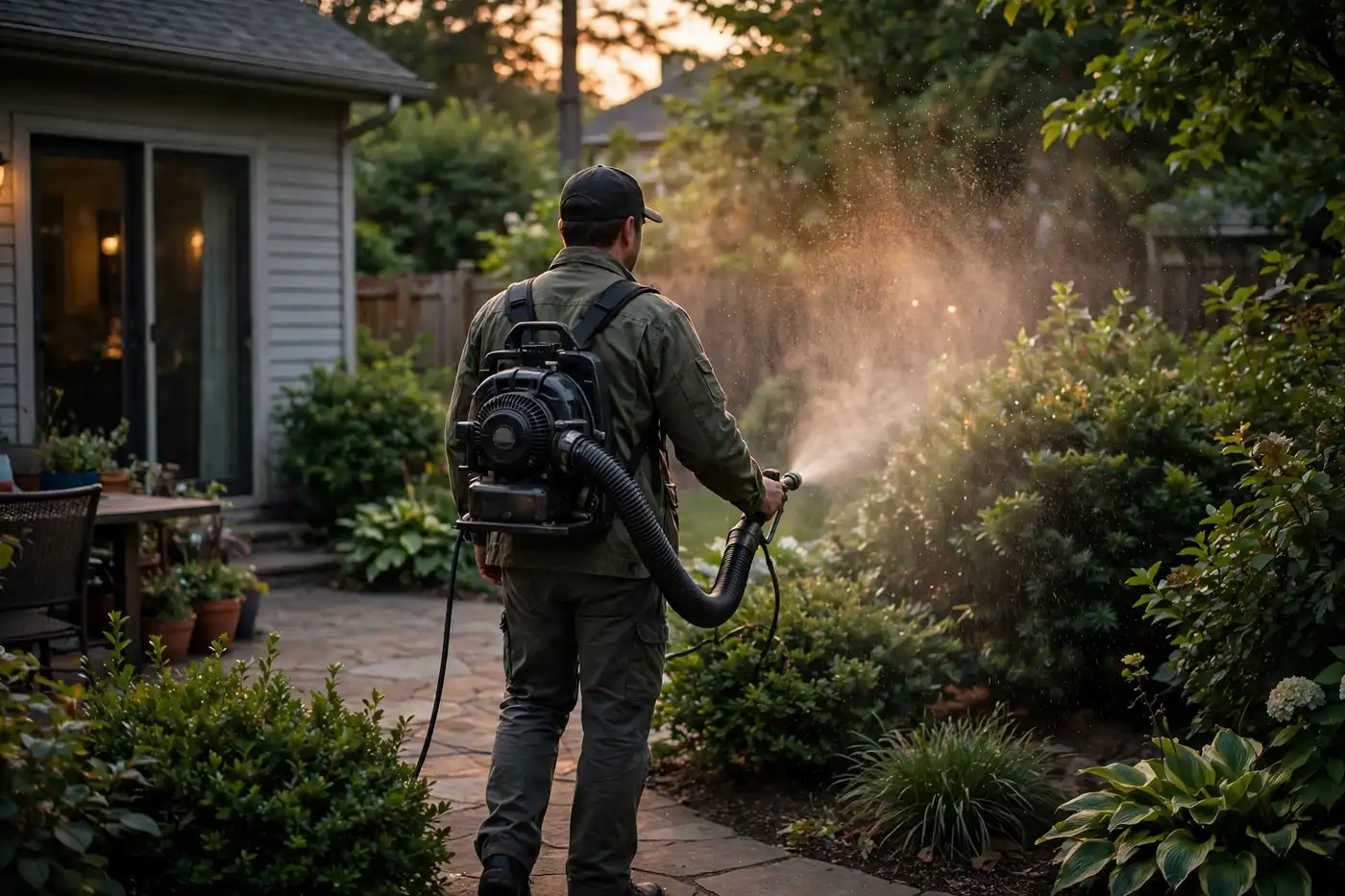
Mosquitoes breed wherever water stands — clogged gutters, pot saucers, tarps, low lawn spots — and rest by day in shaded foliage. Local pressure can run most of the year, and the species biting at your patio were most likely hatched within a few hundred feet of it. In Jacksonville, the breeding audit usually finds the culprits within fifty feet of the patio — a clogged gutter, a sagging tarp, the saucer under a planter — which is why the yard walk matters as much as the treatment. More about mosquito control.

Red imported fire ants

A fire ant colony defends a territory, not just a mound: disturb it and workers pour out in seconds, and a flooded or treated colony simply relocates — sometimes into the neighbour's yard or a wall void. Programmes use broadcast bait across the whole area plus individual mound treatment, because colony-by-colony whack-a-mole never catches up with budding. In Jacksonville, the pattern providers plan around is the post-rain surge — fresh mounds along drives, beds and meter bases within days of a storm, which is when bait goes down and when mound counts are honestly compared. More about ant control.

American cockroaches (palmetto bugs)

Large outdoor cockroaches are a fixture of warm-climate life: they breed in mulch, litter and drains and push indoors seasonally. Managing them is about treating the harbourage outside and sealing the routes in. After a heavy rain in Jacksonville, the sightings spike — these roaches move up out of drains and mulch as the water rises — so providers here check floor drains and door thresholds as carefully as any kitchen. More about cockroach control.

German cockroaches

The German cockroach is the kitchen pest that defines professional patience: egg cases hatch for weeks, populations resist common sprays, and control means vacuuming, gel baits in the harbourages, and scheduled follow-ups until monitoring runs clean. Providers in Jacksonville open the appliance voids first — behind the fridge, under the sink, inside the dishwasher frame — because that warm, dark geography is where this species lives, and where the bait has to go. More about cockroach control.

Roof rats

Roof rats treat the neighbourhood's fences and tree canopy as highways into attics. Once inside they shred insulation and gnaw wiring; the durable fix is a trapping programme combined with proper exclusion at every eave, vent and roof return. Jacksonville roof rats run the fences and the tree canopy, so local exclusion work starts with branches off the roof and every eave and vent screened, before a single trap is set. More about rodent control.

Fleas

Most of a flea infestation is not on the pet: eggs roll off into carpets and floor cracks, larvae develop in the dark fibres, and pupae can wait months for vibration to signal a host. Treatment therefore covers the home as well as the animal — vacuuming that triggers emergence, treatment of floors and pet resting areas, and a return visit timed to the hatch. In Jacksonville, flea calls spike a few weeks into the warm season, when the pupae banked in carpets and shaded pet runs start hatching in waves — timing the programme to that curve is the local skill. More about flea & tick control.

Termite Control & Inspection in Jacksonville
The local priority in Jacksonville: subterranean termites. Termite Control & Inspection explains how the work is done.

A year of pest pressure in Jacksonville

Pest pressure here is seasonal, and the calendar matters more than any single treatment.

Spring: Spring opens the year hard: subterranean and Formosan termite swarms, fire ant mounds after rain, and the first mosquito waves.

Summer: Summer is the Gulf pattern at full strength — heat, daily storms and standing water everywhere; roaches, ants and mosquitoes peak together.

Autumn: Autumn keeps the pressure high, with rodents moving toward structures and termite colonies still feeding.

Winter: Winter slows outdoor activity but rarely stops it; indoor cockroaches and overwintering rodents carry the season.

Hurricane season writes its own chapter in Jacksonville: storm flooding drives ground pests — ants, roaches, rodents — out of drowned harbourage and into homes, often in the same week a property is drying out. Post-storm inspections here look for exactly that displacement, plus the moisture damage that invites termites and carpenter ants in the months that follow.

Jacksonville homes and pest risk

What the climate proposes, the housing stock disposes — construction and age decide which homes get hit.

The metro counts about 713,833 housing units; with 33% dating from before 1980, much of the stock has the mature landscaping, settled foundations and utility penetrations that pests exploit.

The building-era mix adds texture: about 30% of homes went up between 1980 and 1999, the era of slab and crawlspace suburbs, while 14% predate 1960 entirely. Each era has its pest signature — older homes leak at every joint; newer ones hide pests in foam, voids and landscape beds built tight against the walls.

It is why local providers spend so much of an inspection on gaps, vents and door sweeps rather than on product.

Before a visit, local providers ask for the basics: clear access to baseboards and problem rooms, pet bowls and toys picked up, and a note of where you have seen activity — the inspection follows your evidence.

What a local inspection covers in Jacksonville

A local inspection in Jacksonville follows the pests, not a script. Outside, the technician reads the foundation line, mulch beds, eaves and utility entries for subterranean termites and Formosan termites first, because those are the metro's headline problems; inside, the route runs through the kitchen and bathroom plumbing, the attic and any crawlspace or basement the home has. What they write down — species, entry points, conducive conditions — is what the treatment plan gets built on, and it is why two neighbouring homes can legitimately end up with different programmes.

Mosquito Control in Jacksonville
Second on the Jacksonville list: Formosan termites. Mosquito Control covers how that work is done.

A word on choosing well in Jacksonville: favour the provider who inspects before quoting, names the species before treating, and puts the plan — scope, schedule, what is excluded — in writing. Be cautious with anyone who quotes a full programme over the phone sight-unseen, or who leans on urgency. Pest problems here are real, but they are measured in days and weeks, not minutes, and a good local company knows it.

Neighbourhoods and ZIP codes covered in Jacksonville

Providers in the network serve the Jacksonville metro across 14 named communities and the surrounding suburbs. The largest include Jacksonville (about 961,739 residents), Fruit Cove (about 35,609 residents), Lakeside (about 31,548 residents), Oakleaf Plantation (about 30,737 residents), Fleming Island (about 29,351 residents), Nocatee (about 25,581 residents). Pest pressure follows the metro's neighbourhoods rather than its municipal lines — a home in any of these communities sits on the same climate and housing map described above. A sample of ZIP codes covered locally:

320033200932011320333203432040320433204632063320653206832072320733207932080320813208232084320863208732092320953209732145

If your ZIP is not listed, call anyway — coverage follows the metro area, not a fixed list, and new routes are added as local providers join.

Counties in the Jacksonville metro

The metro spans 5 counties. Each county page covers its local pest pressure and the city pages that serve it.

The metro's principal county is Baker County at about 585 square miles; altogether the 5 counties below cover roughly 3,202 square miles of Florida and neighbouring state land. County lines matter for pest work because licensing, and in some areas wildlife rules, run at state and county level — your provider works to the rules where your property sits.

Jacksonville among its neighbouring metros

The Jacksonville metro does not sit alone: Gainesville, FL is about 70 miles off, Ocala, FL about 72, and Daytona Beach, FL about 75. Weather, pest seasons and housing styles carry across those distances, which is why this site reads the region as a whole while routing every call to the providers of one specific metro.

Nearby metro areas

Pest control services in Jacksonville

How PestReach USA works

1

Call and describe the problem

Tell us what you are seeing — ants in the kitchen, a nest under the eaves, scratching in the attic — and where you are located.

2

We connect you locally

Your call is routed to an independent local pest control professional who serves your area and handles your type of problem.

3

They inspect and treat

The provider inspects, identifies the pest, explains the plan and its terms directly to you, and carries out the work.

Frequently asked questions

What is the most common pest problem in Jacksonville, FL?

The pests Jacksonville homeowners call about most are subterranean termites and Formosan termites, driven by long, hot, humid summers and mild winters that let pests breed nearly year-round. Locally that plays out street by street — providers cover 5 counties around Jacksonville, including the area around Jacksonville. Termites and rodents cause the most expensive damage, while ants and cockroaches generate the most calls. A local inspection settles which problem your home actually has — the answer is often not the pest you expected.

How much does pest control cost in Jacksonville, FL?

PestReach USA is a referral service and does not set prices — your local provider quotes their own work after inspecting, because the honest price depends on the pest, the size of the property and whether the job is a one-off removal or a recurring programme. That is as true in Jacksonville as in central Jacksonville — local providers plan by metro and county, not by neighbourhood lines. What we can tell you is what drives the figure: infestation size, access, treatment method and follow-up schedule. Be wary of any quote given without an inspection.

When is pest season in Jacksonville, FL?

There is no single off-switch: pressure peaks from spring through autumn, with subterranean termites leading the warm months, while indoor pests — cockroaches, bed bugs, rodents in the structure — stay active all year. Locally that plays out street by street — providers cover 5 counties around Jacksonville, including the area around Jacksonville. The local pattern is set by long, hot, humid summers and mild winters that let pests breed nearly year-round, so well-timed prevention ahead of your problem pest's peak is worth more than reaction after it.

Do I need year-round pest control in Jacksonville, FL?

Many Jacksonville homes benefit from it, because the exterior barrier that stops most invaders weathers down over one to three months and pest pressure here is not confined to one season. That is as true in Jacksonville as in central Jacksonville — local providers plan by metro and county, not by neighbourhood lines. Homes with lighter pressure — newer construction, few entry points, no history of infestation — may do well with seasonal or as-needed service. An inspection gives you the honest read for your property.

What pests should I watch for in an older home in Jacksonville, FL?

With 33% of the metro's homes built before 1980, the recurring themes are pests of gaps and voids: rodents travelling wall voids, carpenter ants in moisture-damaged wood, and insects entering at settled joints and utility penetrations. In practice, routing follows the metro's real map: ZIP codes such as 32003 and communities like Jacksonville are on local providers' regular runs. Older homes reward a thorough exclusion pass — sealing and screening — alongside any treatment.

Can a provider help with pests in my attic in Jacksonville, FL?

Yes — attics are one of the most common work sites locally, whether the problem is roof rats, squirrels, bats, wasps or overwintering insects. That is as true in Jacksonville as in central Jacksonville — local providers plan by metro and county, not by neighbourhood lines. The correct response is inspection first: identify the animal or insect, find every entry point at the roof line, remove or evict what is there, and seal the entries so the attic stays empty. Treating without sealing is a subscription to the same problem.

Which parts of Jacksonville, FL do providers cover?

Coverage follows the metro rather than the city limit: providers serve Jacksonville itself — including ZIP codes such as 32003 — and the surrounding communities this page lists, from Jacksonville outward across the metro's 5 counties. Locally that plays out street by street — providers cover 5 counties around Jacksonville, including the area around Jacksonville. If your address sits near the metro's edge, say so when you call; routing is done on the provider's actual service map, and the neighbouring metros listed on this page are covered by their own local providers if your property falls on that side of the line.

What should I do before a pest treatment visit in Jacksonville, FL?

Preparation depends on the pest, and your provider will give you a specific list — but the pattern in Jacksonville homes is consistent: clear access to baseboards, sinks and the areas where activity was seen; put food, utensils and pet bowls away; arrange for pets and children to be out of treated rooms for the period the provider specifies. Around Jacksonville, the same answer holds from the core out to Jacksonville — the providers' routes, not the city limit, define the map. For rodents and wildlife, note where you have heard or seen activity and when. None of this is busywork — preparation is the difference between treatment reaching the harbourage and treatment reaching only the open floor.

Pest problem in Jacksonville?

Call now — we will connect you with an independent local provider for an inspection and a clear plan.

Call Now

Mon-Fri 7:00 AM-10:00 PM ET | Sat 8:00 AM-10:00 PM ET | Sun 7:00 AM-9:00 PM ET