Ask what keeps Slidell providers busiest and the answer is subterranean termites, Formosan termites and mosquitoes — pests written into the calendar by a climate where long, hot, humid summers and mild winters that let pests breed nearly year-round. We connect you with a local independent provider who starts with an inspection.
Phone lines: Mon-Fri 7:00 AM-10:00 PM ET | Sat 8:00 AM-10:00 PM ET | Sun 7:00 AM-9:00 PM ET
The pests that matter in Slidell are the ones its climate feeds and its housing shelters — and both are predictable once you read them.
It adds up in the weather record: roughly 62 inches of precipitation annually, 80 days of 90°F-plus heat, and a yearly average temperature of about 68°F.
The Slidell–Mandeville–Covington area is home to roughly 279,108 people, and its 103,286 households share the same pest calendar.
The structural pest that matters most here is the subterranean termite. Colonies forage from underground nests and build pencil-width mud tubes up foundation walls to reach wood, which is why damage so often stays hidden until it is extensive. Annual inspections are the standard defence in country like this. In Slidell, the annual inspection is treated as a standing appointment for a reason — colonies here forage year-round underground, and the gap between a clean report and a mud tube can be a single season of quiet feeding. More about termite control & inspection.
Formosan termites deserve their reputation locally: colonies can number in the millions, swarm on humid late-spring evenings, and — uniquely — establish above-ground nests inside structures where moisture collects. Any termite plan here has to be built with Formosans in mind. In Slidell, the tell-tale is often found overhead: inspectors carry ladders here because this species nests in roofs and wall voids wherever a slow leak keeps timber damp, far above the soil line most people associate with termites. More about termite control & inspection.
Mosquitoes breed wherever water stands — clogged gutters, pot saucers, tarps, low lawn spots — and rest by day in shaded foliage. Local pressure can run most of the year, and the species biting at your patio were most likely hatched within a few hundred feet of it. In Slidell, the breeding audit usually finds the culprits within fifty feet of the patio — a clogged gutter, a sagging tarp, the saucer under a planter — which is why the yard walk matters as much as the treatment. More about mosquito control.
The sting is the signature, but the damage list is longer: colonies invade electrical boxes, pad-mounted equipment and irrigation controls, shorting what they nest in. Local treatment plans account for that — bait timed to foraging activity in the cooler parts of the day, mounds treated directly, and equipment housings checked as part of the visit. In Slidell, the pattern providers plan around is the post-rain surge — fresh mounds along drives, beds and meter bases within days of a storm, which is when bait goes down and when mound counts are honestly compared. More about ant control.
Seeing one indoors usually means weather or plumbing has moved it, not that the house is infested. Providers trace the route — floor drains, pipe chases, gaps under doors — treat the outdoor harbourages driving the pressure, and reserve indoor work for the voids and drains where these roaches actually travel. After heavy rain in Slidell, these big roaches appear in garages and ground-floor bathrooms as flooded harbourage empties — a weather event more than an infestation, handled at the perimeter and the drains. More about cockroach control.
The German cockroach is the kitchen pest that defines professional patience: egg cases hatch for weeks, populations resist common sprays, and control means vacuuming, gel baits in the harbourages, and scheduled follow-ups until monitoring runs clean. In Slidell kitchens the giveaway is daytime activity — a colony visible by day is a large one — and providers respond with bait placements counted in dozens, mapped to the appliance voids the roaches actually occupy. More about cockroach control.

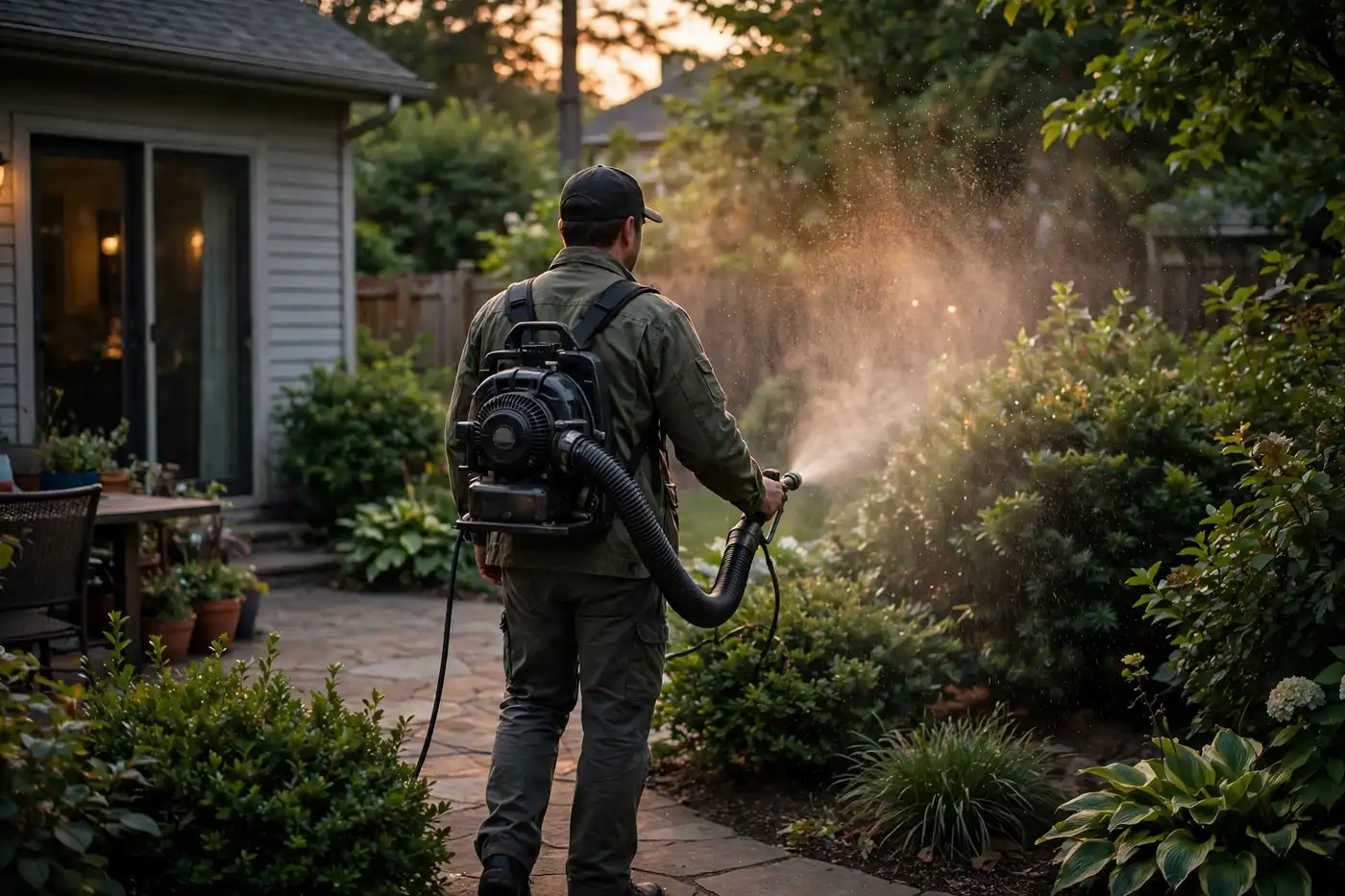
Knowing which pest peaks when is half of local control; this is the Slidell pattern.
Spring: Spring opens the year hard: subterranean and Formosan termite swarms, fire ant mounds after rain, and the first mosquito waves.
Summer: Summer is the Gulf pattern at full strength — heat, daily storms and standing water everywhere; roaches, ants and mosquitoes peak together.
Autumn: Autumn keeps the pressure high, with rodents moving toward structures and termite colonies still feeding.
Winter: Winter slows outdoor activity but rarely stops it; indoor cockroaches and overwintering rodents carry the season.
Hurricane season writes its own chapter in Slidell: storm flooding drives ground pests — ants, roaches, rodents — out of drowned harbourage and into homes, often in the same week a property is drying out. Post-storm inspections here look for exactly that displacement, plus the moisture damage that invites termites and carpenter ants in the months that follow.
Housing decides how that pressure plays out at a specific address.
About 23% of the metro's homes were built before 1980, and 4% before 1960 — older framing means more gaps, more settled joints, and more of the hidden voids pests travel through.
Vacancy and turnover play a role too: with 112,414 housing units against 103,286 households, the metro carries the usual share of empty and between-tenant properties — and undisturbed homes are where bed bugs wait out vacancies, rodents nest unnoticed and termite damage runs longest before discovery.
Practical translation: exclusion — sealing, screening, sweeping — is worth as much as any treatment in homes of this vintage.
Preparation here is light for routine work: access to the foundation line and problem rooms, food put away in treatment areas, and your own notes on sightings, which steer the inspection to the right harbourages.
What should you expect an inspection in Slidell to actually cover? The exterior envelope first — roof line, vents, weep holes, door sweeps, the gaps where pipes and cables enter — then the interior hot spots where moisture and warmth concentrate. With subterranean termites and Formosan termites leading the local call log, a Slidell inspector spends real time on the harbourages those pests use, and checks the quiet places — attic insulation, stored items, under-sink voids — where infestations announce themselves late.

Providers in the network serve the Slidell metro across 12 named communities and the surrounding suburbs. The largest include Slidell (about 28,664 residents), Mandeville (about 12,931 residents), Covington (about 11,568 residents), Eden Isle (about 7,753 residents), Lacombe (about 6,883 residents), Abita Springs (about 2,669 residents). Note how the list reads: these communities share one pest map — the same climate, the same housing eras, the same seasonal calendar — whatever their municipal boundaries say. A sample of ZIP codes covered locally:
If your ZIP is not listed, call anyway — coverage follows the metro area, not a fixed list, and new routes are added as local providers join.
The metro spans 1 counties. Each county page covers its local pest pressure and the city pages that serve it.
The metro's principal county is St. Tammany Parish at about 845 square miles; altogether the 1 counties below cover roughly 845 square miles. The patchwork matters practically: licences are issued by the state, wildlife rules can vary, and a provider's route is planned county by county — the county pages below give each one its own pest reading.
Pest pressure is regional, and Slidell's map shades into its neighbours': the New Orleans, LA metro lies about 40 miles away, Baton Rouge, LA about 70, and Houma, LA about 80 — close enough that the same weather systems, and largely the same pest calendar, run across all of them. Providers stay local to their own metro, but the reading of the seasons is shared.
Tell us what you are seeing — ants in the kitchen, a nest under the eaves, scratching in the attic — and where you are located.
Your call is routed to an independent local pest control professional who serves your area and handles your type of problem.
The provider inspects, identifies the pest, explains the plan and its terms directly to you, and carries out the work.
PestReach USA is a referral service and does not set prices — your local provider quotes their own work after inspecting, because the honest price depends on the pest, the size of the property and whether the job is a one-off removal or a recurring programme. Homeowners near Slidell hear the same guidance: the metro's providers work the whole area, ZIP 70420 included. What we can tell you is what drives the figure: infestation size, access, treatment method and follow-up schedule. Be wary of any quote given without an inspection.
Yes — Slidell sits in active termite country, where the combination of long, hot, humid summers and mild winters that let pests breed nearly year-round keeps colonies feeding. Locally that plays out street by street — providers cover 1 counties around Slidell, including the area around Slidell. Subterranean termites are the main structural threat locally, and because they work out of sight, annual inspections are the standard recommendation for homes here regardless of age. Swarmers in spring, mud tubes on the foundation or hollow-sounding wood are all reasons to book an inspection promptly.
Yes — attics are one of the most common work sites locally, whether the problem is roof rats, squirrels, bats, wasps or overwintering insects. In practice, routing follows the metro's real map: ZIP codes such as 70420 and communities like Slidell are on local providers' regular runs. The correct response is inspection first: identify the animal or insect, find every entry point at the roof line, remove or evict what is there, and seal the entries so the attic stays empty. Treating without sealing is a subscription to the same problem.
Availability depends on the local provider's schedule and the urgency of the problem — stinging nests, rodents in living space and confirmed bed bug activity are normally prioritised. In practice, routing follows the metro's real map: ZIP codes such as 70420 and communities like Slidell are on local providers' regular runs. When you call, describe the problem precisely; PestReach USA routes you to a local provider who will give you their real earliest appointment rather than a promise we cannot keep.
Preparation depends on the pest, and your provider will give you a specific list — but the pattern in Slidell homes is consistent: clear access to baseboards, sinks and the areas where activity was seen; put food, utensils and pet bowls away; arrange for pets and children to be out of treated rooms for the period the provider specifies. Around Slidell, the same answer holds from the core out to Slidell — the providers' routes, not the city limit, define the map. For rodents and wildlife, note where you have heard or seen activity and when. None of this is busywork — preparation is the difference between treatment reaching the harbourage and treatment reaching only the open floor.
Call now — we will connect you with an independent local provider for an inspection and a clear plan.
Call NowMon-Fri 7:00 AM-10:00 PM ET | Sat 8:00 AM-10:00 PM ET | Sun 7:00 AM-9:00 PM ET