Argentine ants, drywood termites and roof rats lead the local call log — the predictable result of a metro where dry summers, mild wet winters and year-round moderate temperatures pests can work with. PestReach USA routes you to an independent provider who inspects first.
Phone lines: Mon-Fri 7:00 AM-10:00 PM ET | Sat 8:00 AM-10:00 PM ET | Sun 7:00 AM-9:00 PM ET
Yuba City sits in mediterranean country, and its pest calendar follows that geography faithfully.
Consider the climate the pests work with: 20 inches of rain in a typical year, 99 days at 90°F or above, and heating demand that shows how real the winters are.
Across the Yuba City metro — about 187,478 people in 61,303 households — that pressure lands on housing of every age and type.
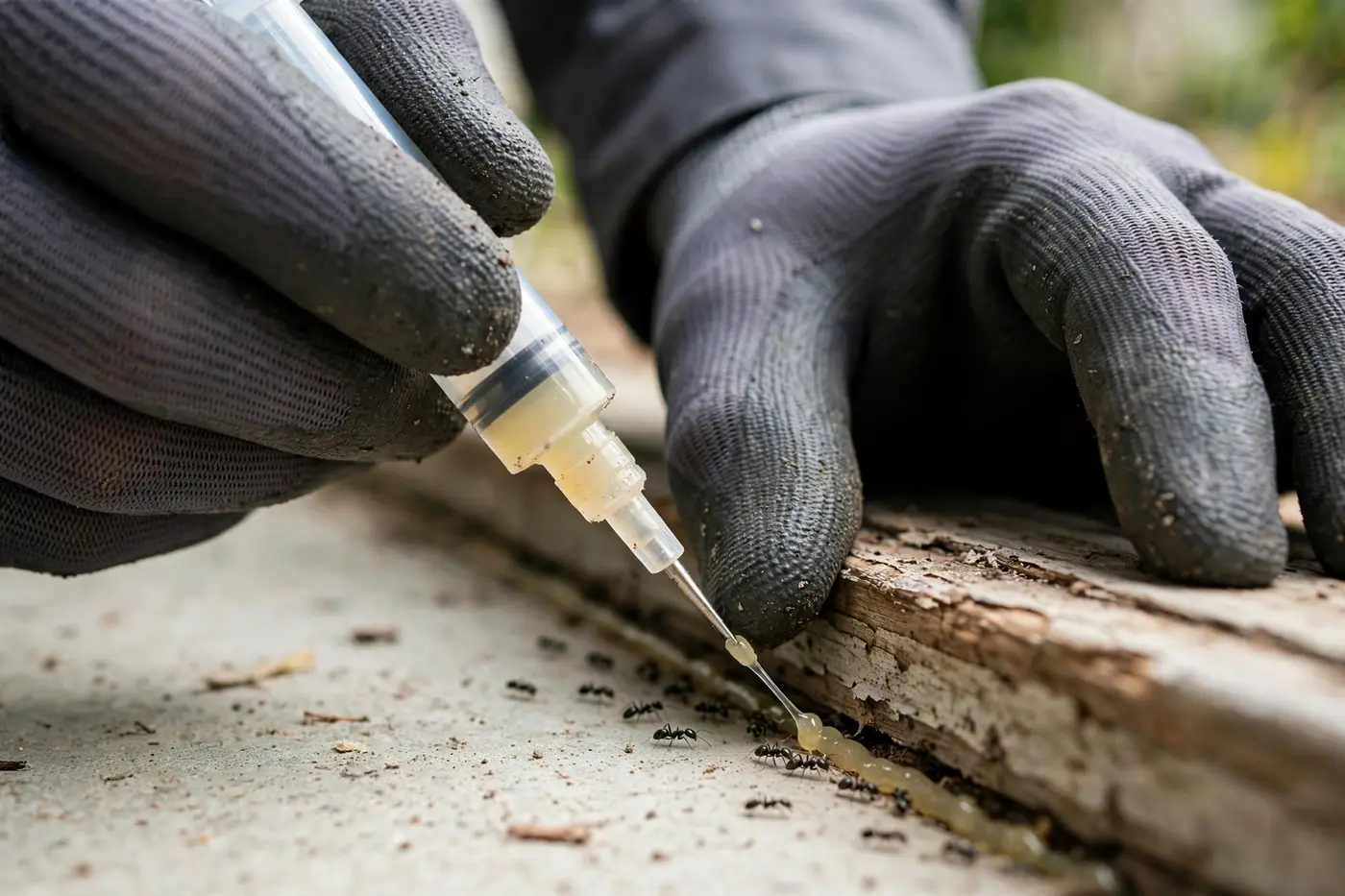
Their trails run like roads: up tree trunks to honeydew-producing insects, along fence lines, into kitchens at the first dry spell. Local programmes treat the trees and the trails as one system, protect the bait from irrigation, and refresh it on schedule — consistency across weeks is what bends a supercolony's numbers down. In Yuba City the trails ignore property lines, so providers treat the perimeter and the landscape as one system and set expectations about suppression rather than a finish line. More about ant control.
Drywood termites are the quiet specialists of warm, dry country: they colonise wood directly — eaves, trim, framing, furniture — and reveal themselves mainly through piles of seed-like frass beneath kick-out holes. Localised colonies are treated very differently from soil termites, so identification comes first. In Yuba City the giveaway is housekeeping: neat little piles of pellets beneath eaves, window frames and attic vents, swept up by homeowners for months before anyone names them. More about termite control & inspection.
Roof rats treat the neighbourhood's fences and tree canopy as highways into attics. Once inside they shred insulation and gnaw wiring; the durable fix is a trapping programme combined with proper exclusion at every eave, vent and roof return. In Yuba City, the roofline is the front door: inspectors walk the eaves looking for the greasy rub marks and the thumbnail gap at a vent or soffit that a rat uses nightly, and sealing that gap is the heart of the job. More about rodent control.
Black widows keep to undisturbed, ground-level shelter — woodpiles, meter boxes, under stones and stored equipment — where the female's messy web waits for passing insects. They are shy and bite only when pressed, but their harbourages are exactly where hands go, so those zones get targeted attention. Around Yuba City, widow checks focus on the stored and the still — meter boxes, woodpiles, the undersides of patio furniture — where a web can sit undisturbed for a whole season. More about spider control.
Sprays alone often make this species worse, scattering colonies into new voids — the pattern called budding. Providers here rely on gel baits the roaches carry back to the harbourage, insect growth regulators that break the breeding cycle, and sanitation of the grease and moisture that sustain them, checked and refreshed across several visits. In Yuba City kitchens the giveaway is daytime activity — a colony visible by day is a large one — and providers respond with bait placements counted in dozens, mapped to the appliance voids the roaches actually occupy. More about cockroach control.
Fleas run their life cycle in carpets, pet bedding and shaded yard soil — the biting adults on a pet are a small fraction of the infestation. Warm, humid conditions let them cycle nearly year-round, so pet, home and yard have to be treated together. In Yuba City, flea calls spike a few weeks into the warm season, when the pupae banked in carpets and shaded pet runs start hatching in waves — timing the programme to that curve is the local skill. More about flea & tick control.

Pest pressure here is seasonal, and the calendar matters more than any single treatment.
Spring: Spring starts the ant season in earnest, with Argentine ant trails expanding and fleas building on wildlife and pets.
Summer: Summer's dry heat pushes pests toward irrigated landscaping and the moisture around homes — ants, roof rats and drywood termite swarms.
Autumn: Autumn brings rodent movement toward structures and the last wasp peak.
Winter: Mild, wet winters keep moisture pests and indoor cockroaches active while rodents press the roof line.
The cold-snap pattern shapes Yuba City's winter workload: long mild stretches interrupted by sudden freezes that send mice, rats and overwintering insects into structures all at once. Local providers urge the sealing conversation in autumn, because once the snap arrives everyone wants the same appointment in the same week.
The same weather produces different problems in different houses, and Yuba City's housing mix explains a lot.
About 46% of the metro's homes were built before 1980, and 18% before 1960 — older framing means more gaps, more settled joints, and more of the hidden voids pests travel through.
Vacancy and turnover play a role too: with 64,770 housing units against 61,303 households, the metro carries the usual share of empty and between-tenant properties — and undisturbed homes are where bed bugs wait out vacancies, rodents nest unnoticed and termite damage runs longest before discovery.
It is why local providers spend so much of an inspection on gaps, vents and door sweeps rather than on product.
Preparation here is light for routine work: access to the foundation line and problem rooms, food put away in treatment areas, and your own notes on sightings, which steer the inspection to the right harbourages.
The inspection is where Yuba City pest control is won. A proper visit maps three things: which species are present (starting with Argentine ants and drywood termites, the metro's most-called-about pests), how they are getting in, and what the property is offering them in food, water and shelter. Only with that map does treatment selection make sense — the same product that collapses one problem can scatter another, which is why identification always precedes application here.

Providers in the network serve the Yuba City metro across 14 named communities and the surrounding suburbs. The largest include Yuba City (about 69,545 residents), Linda (about 23,215 residents), Olivehurst (about 19,071 residents), Marysville (about 12,703 residents), Live Oak (about 9,264 residents), Plumas Lake (about 8,424 residents). Note how the list reads: these communities share one pest map — the same climate, the same housing eras, the same seasonal calendar — whatever their municipal boundaries say. A sample of ZIP codes covered locally:
If your ZIP is not listed, call anyway — coverage follows the metro area, not a fixed list, and new routes are added as local providers join.
The metro spans 2 counties. Each county page covers its local pest pressure and the city pages that serve it.
The metro's principal county is Sutter County at about 603 square miles; altogether the 2 counties below cover roughly 1,235 square miles. The patchwork matters practically: licences are issued by the state, wildlife rules can vary, and a provider's route is planned county by county — the county pages below give each one its own pest reading.
The Yuba City metro does not sit alone: Sacramento, CA is about 35 miles off, Chico, CA about 36, and Vallejo, CA about 65. Weather, pest seasons and housing styles carry across those distances, which is why this site reads the region as a whole while routing every call to the providers of one specific metro.
Tell us what you are seeing — ants in the kitchen, a nest under the eaves, scratching in the attic — and where you are located.
Your call is routed to an independent local pest control professional who serves your area and handles your type of problem.
The provider inspects, identifies the pest, explains the plan and its terms directly to you, and carries out the work.
The pests Yuba City homeowners call about most are Argentine ants and drywood termites, driven by dry summers, mild wet winters and year-round moderate temperatures pests can work with. In practice, routing follows the metro's real map: ZIP codes such as 95659 and communities like Yuba City are on local providers' regular runs. Termites and rodents cause the most expensive damage, while ants and cockroaches generate the most calls. A local inspection settles which problem your home actually has — the answer is often not the pest you expected.
Yes — Yuba City sits in active termite country, where the combination of dry summers, mild wet winters and year-round moderate temperatures pests can work with keeps colonies feeding. That is as true in Yuba City as in central Yuba City — local providers plan by metro and county, not by neighbourhood lines. Subterranean termites are the main structural threat locally, and because they work out of sight, annual inspections are the standard recommendation for homes here regardless of age. Swarmers in spring, mud tubes on the foundation or hollow-sounding wood are all reasons to book an inspection promptly.
Many Yuba City homes benefit from it, because the exterior barrier that stops most invaders weathers down over one to three months and pest pressure here is not confined to one season. Homeowners near Yuba City hear the same guidance: the metro's providers work the whole area, ZIP 95659 included. Homes with lighter pressure — newer construction, few entry points, no history of infestation — may do well with seasonal or as-needed service. An inspection gives you the honest read for your property.
With 46% of the metro's homes built before 1980, the recurring themes are pests of gaps and voids: rodents travelling wall voids, carpenter ants in moisture-damaged wood, and insects entering at settled joints and utility penetrations. Around Yuba City, the same answer holds from the core out to Yuba City — the providers' routes, not the city limit, define the map. Older homes reward a thorough exclusion pass — sealing and screening — alongside any treatment.
Yes — attics are one of the most common work sites locally, whether the problem is roof rats, squirrels, bats, wasps or overwintering insects. For Yuba City addresses that map runs across 2 counties, with Yuba City among the communities on regular routes. The correct response is inspection first: identify the animal or insect, find every entry point at the roof line, remove or evict what is there, and seal the entries so the attic stays empty. Treating without sealing is a subscription to the same problem.
Call now — we will connect you with an independent local provider for an inspection and a clear plan.
Call NowMon-Fri 7:00 AM-10:00 PM ET | Sat 8:00 AM-10:00 PM ET | Sun 7:00 AM-9:00 PM ET